

Does Curiosity Have a Dark Side?

Curiosity has always been one of the strongest drivers of progress, shaping discoveries, inventions, and entire civilizations. Yet the same force that pushes humanity toward understanding can also unsettle it. Human curiosity often walks a fine line between wonder and disruption, especially when what is discovered challenges established beliefs or comfort zones.
Curiosity as a Force That Splits Wonder and Alarm
At its core, curiosity promises expansion of knowledge, yet it also exposes individuals and societies to instability. Human curiosity drives scientists to explore signals from unknown sources, but the moment those signals challenge established frameworks, a fear response can surface.
This duality is central to human behavior, where the desire to know competes with the instinct to remain safe. In many cases, resistance to change is not rooted in ignorance but in emotional protection mechanisms that respond to change and uncertainty with caution rather than openness.
First Contact and the Rise of Collective Alarm
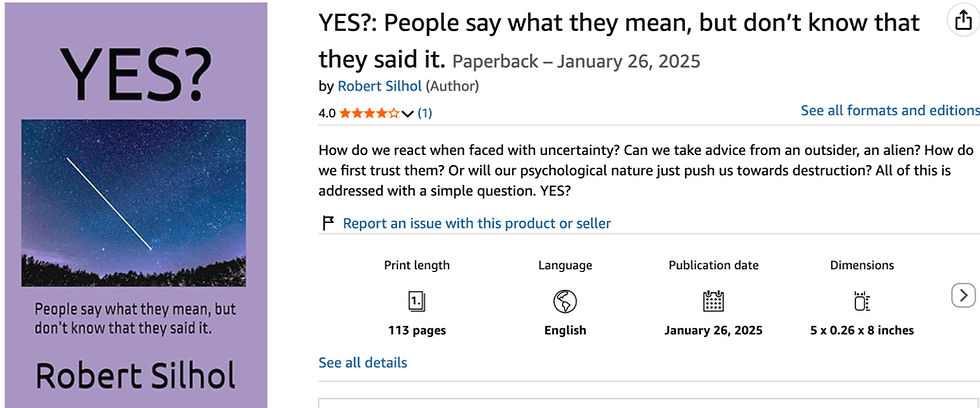
In YES? By Robert Silhol, the discovery of a cryptic extraterrestrial message at observatories such as Meudon and Berkeley transforms scientific curiosity into global instability. The message “WHAT CAN WE DO FOR YOU?” followed by the enigmatic “YES?” sparks not just analysis but widespread panic. Governments and institutions interpret the event through a lens of threat management, revealing how quickly fear response can dominate human behavior when confronted with incomprehensible signals.
What begins as human curiosity in scientific circles rapidly escalates into a societal crisis shaped by resistance to change, especially once the media reframes the message as a form of cosmic bargaining. The narrative highlights how change and uncertainty can distort meaning when filtered through institutional alarm.
Society and Resistance to Change
The fictional hysteria in Silhol’s narrative mirrors present-day patterns where technological, scientific, or cultural shifts are often met with hesitation. In contemporary settings, resistance to change frequently appears in debates around artificial intelligence, climate science, and biotechnology.
Despite increased access to information, human curiosity is often restrained by collective doubt, where a fear response becomes amplified through social media and rapid communication. This dynamic reflects broader human behavior, where uncertainty spreads faster than understanding.
In this context, change and uncertainty are no longer abstract ideas but daily realities that influence how societies adapt or resist transformation.
Psychology Behind Discovery and Disruption
Silhol’s narrative structure in YES? also emphasizes psychological interpretation, particularly through characters like Catherine, who analyzes communication through emotional and cognitive lenses.
When human curiosity encounters ambiguous signals, the mind seeks patterns that reduce discomfort, reinforcing resistance to change. At this psychological level, change and uncertainty become catalysts for both insight and distortion.
When Curiosity Stops Seeking Safety
In YES? by Robert Silhol, communication with the unknown becomes possible, yet comprehension remains fractured by interpretation, emotion, and denial. That gap is where human curiosity becomes most revealing, not as a pure pursuit of knowledge, but as a test of how well societies can endure change and uncertainty without collapsing into a fear response.
Perhaps the real threshold of evolution begins at the exact point where control is lost, and interpretation becomes unstable. That is where curiosity either hardens into fear or matures into understanding.


Comments