

Exploring the Unforeseen: A Journey Through Robert Silhol's YES?

Updated: Jul 3

A Glimpse into the Unknown
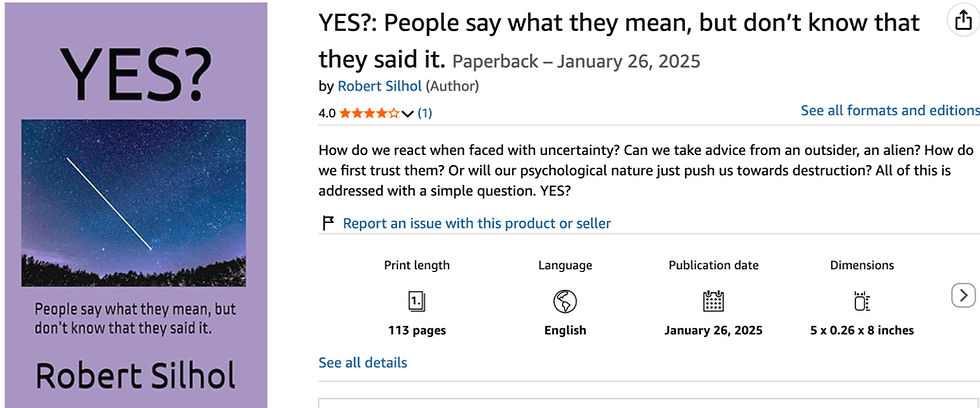
What happens when humanity receives a message from the future, and it is not what we expect? In YES?, Robert Silhol invites readers into a world where science, philosophy, and existential inquiry collide. The story begins quietly at the Meudon Observatory near Paris. Here, astronomers Jerome and Robert notice an unusual computer prompt: “YES?” What seems like a routine anomaly quickly grows into a global phenomenon. This phenomenon challenges everything humans think they know about communication and themselves.
The Global Response
Across the world, observatories struggle to interpret these signals. The messages escalate from curiosity to urgency. The source is not another civilization in a distant galaxy but a future version of humanity itself. Silhol’s narrative examines the unsettling idea that we may already be on a path toward our own destruction. The warnings arrive too late to be fully understood, leaving us with more questions than answers.
The Philosophical Weight of Characters
The characters carry the philosophical weight of the novella. Jerome’s analytical curiosity, Marie’s reflective insight, and Robert’s technical focus offer different perspectives on humanity’s response to the unknown. Through them, Silhol asks whether we are capable of listening to the echoes of our own future and learning from them.
The Mirror of Humanity
YES? is a mirror held up to humanity. It invites readers to question how we communicate, what we value, and whether we can recognize the consequences of our own choices. For fans of thoughtful science fiction, psychological inquiry, and philosophical storytelling, this novella offers a compelling and unsettling journey into both the mind and the future.
The Impact of Communication
In our modern world, communication has evolved dramatically. We rely on technology to connect with one another. Yet, what if that very technology becomes a conduit for messages from our future selves? Silhol's work prompts us to consider the implications of such communication. Are we prepared to heed warnings from a time we have yet to experience?
The Role of Technology in Our Lives
Technology shapes our daily lives. It influences how we interact, learn, and even think. In YES?, Silhol explores the duality of technology as both a tool for progress and a potential harbinger of doom. The characters grapple with this duality, reflecting our own struggles in navigating the complexities of modern life.
A Call to Action
Silhol’s novella serves as a call to action. It challenges us to reflect on our choices and their long-term consequences. Are we listening to the signs around us? Can we change our trajectory before it’s too late? These questions linger long after the final page is turned.
The Philosophical Underpinnings
Philosophy plays a crucial role in YES?. Silhol weaves in existential themes that resonate deeply. The characters’ journeys are not just about understanding the messages from the future; they are also about understanding themselves. This introspection leads to profound realizations about humanity's place in the universe.
The Nature of Existence
What does it mean to exist? This fundamental question echoes throughout the novella. Silhol encourages readers to ponder their own existence and the choices that shape their lives. The characters’ struggles mirror our own, making their journey relatable and thought-provoking.
The Future and Its Implications
The future is often viewed as a distant concept. However, Silhol blurs the lines between past, present, and future. The messages from the future force us to confront our current actions. Are we paving the way for a better tomorrow, or are we repeating the mistakes of the past?
Conclusion: A Journey Worth Taking
In conclusion, YES? is more than just a science fiction novella. It is a profound exploration of humanity's relationship with time, technology, and communication. Silhol’s narrative invites us to reflect on our choices and their impact on the future. It challenges us to listen to the echoes of our own existence and learn from them.
As we navigate our own lives, let us remember the lessons embedded in this thought-provoking tale. The future may hold answers, but we must be willing to ask the right questions. Are we ready to embrace the unknown?
In the end, YES? is not just a question; it is an invitation to engage with the complexities of our existence and the choices that shape our destiny.


Comments