

What Happens When Reason Meets the Irrational Unknown?


by Tom Harold
Human beings are wired to make sense of things. We categorize, analyze, and rely on abstract thinking to create order out of chaos. It gives us confidence, even a sense of power. But that confidence often rests on an illusion of control, one that quietly assumes the universe will always behave in ways we can understand. And when that assumption is challenged, when unknown forces disrupt the structure we depend on, the cracks begin to show.
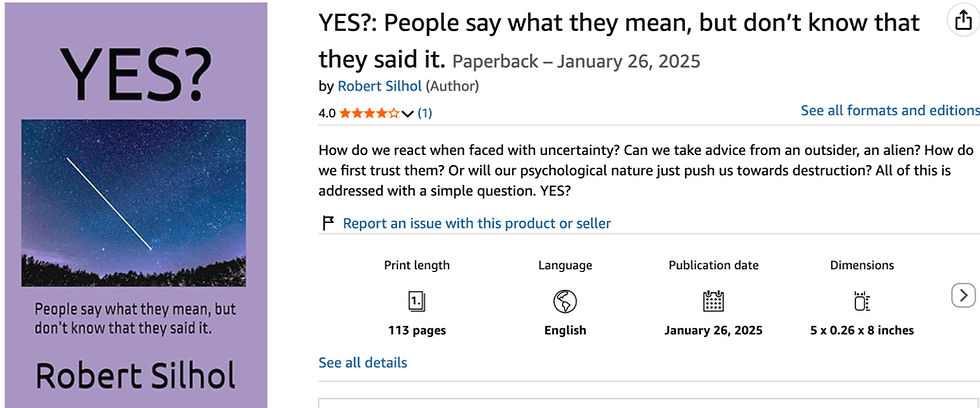
In YES? by Robert Silhol, a simple, polite, almost harmless message unravels the fragile balance between reason and irrationality. What begins as a scientific anomaly evolves into a global psychological crisis, revealing how quickly human certainty dissolves when faced with unknown forces.
The Collapse of Control in a Connected World
What happens when something incomprehensible enters a system built on certainty? It spreads.
As the message leaks to the public, the illusion of control shatters. Media outlets seize it, reshape it, and broadcast it as an invitation. Suddenly, the world is no longer observing the unknown — it is interacting with it, projecting desires onto it, and distorting its meaning.
Marie, the scientific editor and Jerome’s partner, stands at this intersection between knowledge and narrative. She understands how information transforms once it leaves the controlled environment of research. Through her, we see how fragile truth becomes in the hands of mass interpretation.
The Human Mind Against the Unknown
Catherine, the psychologist, offers a different lens. While the scientists chase meaning in data, she searches for meaning in behavior. Her insights reveal something unsettling: the human mind is not equipped to handle pure ambiguity.
Faced with unknown forces, people do not remain neutral. They fill the gaps. They imagine, distort, and project. This is where cognitive limits come into play. The brain, wired for patterns and conclusions, cannot tolerate open-ended uncertainty.
Instead of asking what the message truly means, humanity begins asking what it wants it to mean. Desire overtakes reason. Fear blends with fantasy. And the line between reality and imagination begins to blur.
Serge and Nathalie, the computer specialists, attempt to anchor the situation in technical understanding. They search for origins, signals, and explanations. Yet even their expertise falters. The message exists outside conventional frameworks, highlighting once again the limits of logic in the face of something fundamentally alien.
The Existential Mirror
As the story moves toward its climax, the focus shifts from the message to its source. The extraterrestrial entity finally responds, revealing a connection that reframes everything. Humanity, it seems, resembles what they once were centuries ago.
This revelation is not comforting. It is not even fully explanatory. Instead, it raises more existential questions than it answers. Are humans destined to follow the same path? Are their desires leading them toward growth or destruction?
Why You Should Read This Story
If you’re drawn to narratives that challenge perception, YES? by Robert Silhol has more to it than science fiction mystery. It presents a psychological exploration of how humans confront the unknown, and how often they fail to do so rationally.
Through its characters and its unsettling premise, the novella forces readers to confront their own cognitive limits. It invites reflection on the illusion of control that shapes everyday life and the role abstract thinking plays in both understanding and distorting reality.
Embracing the Mystery
The unknown is not always meant to be conquered. Some unknown forces exist to challenge perception, to stretch awareness, and to reveal the boundaries of human thought. When those boundaries are reached, frustration often follows with existential questions. Yet that frustration is also the beginning of growth.
Real learning begins where certainty ends. The moment you accept that not everything can be explained, you step beyond the illusion of control. You begin to engage with the world not as something to dominate, but as something to explore. And maybe that’s the point.


Comments