

What Does Science Say About A Soul?


By Tom Harold
The age-old question of whether we possess a soul or whether we are simply chemistry, energy, and flesh has puzzled generations for centuries. It has been answered by science, religion, and philosophy, but still, it persists. Perhaps the solution lies somewhere in between reason and faith.
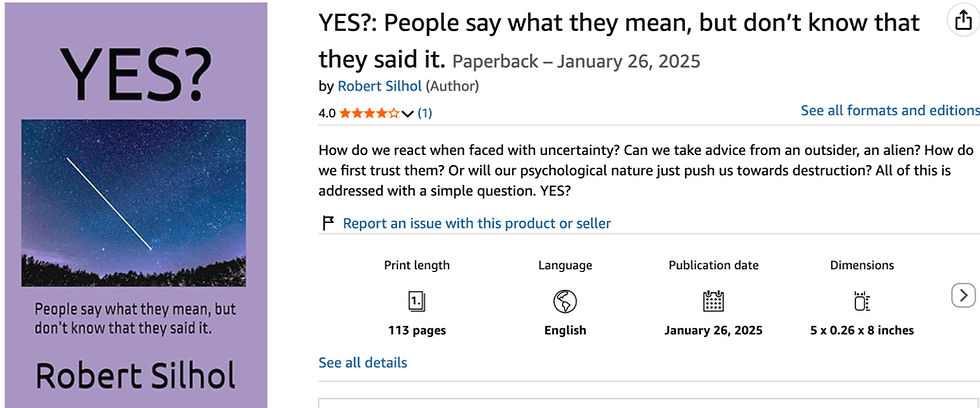
In this regard, YES? by Robert Silhol attempts to capture both sides of the debate through the eyes of Jerome and Marie. The former seeks concrete explanations and evidence, while the latter knows that sometimes you know something before you understand it. Their union represents the dilemma many face in the modern world: the drive to rationalize everything and the awareness that there are things beyond understanding.
Jerome and Marie: Reason vs Wonder
If weird messages suddenly begin to show up on the screens at the observatory, Jerome instinctively looks for a rational explanation for what is happening. He presumes that either there is a malfunction in the system, a practical joke being played, or an intrusion of some kind. His first instinct is pure scientific reasoning. He has faith in the process. He has faith in evidence. He desires knowledge of origin, process, and form.
In contrast, Marie approaches things with a different attitude. She does not dismiss science. Such an attitude would be both lazy and foolish. But instead, she recognizes the inherent limitations of science. She realizes that a sense of wonder is not equivalent to a lack of understanding. She perceives the gravity of the situation and how encountering the unknown requires self-reflection.
It is then that the concept of the soul comes into play.
What Science Can Explain
Neuroscience has had much to say on the topic in recent years. Scientists can trace brain functions, emotional reactions, and even the brain regions responsible for memory, love, fear, and our sense of self. It seems that some scientists think that our soul is simply our brain performing its biological role. If there were no such thing as the brain, there would be no such thing as consciousness.
Unfortunately, the science of consciousness is not as developed as people claim it is.
The truth of the matter is that no one in the entire world is able to give us the reason for the fact that human beings have the capability of becoming self-aware. No one can provide an adequate answer to the reason why we feel feelings like joy, suffering, love, awe, and wonder.
Do Souls Exist After Death?
When people ask, “Do souls exist after death?” they are usually asking the wrong question. They want answers. They want answers that will give them peace of mind. But science doesn’t work like that. Science works with what can be tested, verified, and seen. And maybe the soul does not fall into that category.
Here is where people tend to deceive themselves. Many deny the existence of the soul simply because something they cannot measure must be an illusion. Bad logic! Love is not measurable but everybody knows it’s there. The meaning of life cannot be measured.
Dignity cannot be verified scientifically. But we do not behave as if all these concepts don’t exist.
Many people go to the other extreme and believe that the lack of scientific evidence means that God exists. But lack of information is not proof either. Wishful thinking will never turn into reality.
Limitations of Science and Physics
It’s more difficult to be smarter. It necessitates simultaneously retaining two concepts.
First, the universe operates according to the laws of physics. Matter follows certain laws. The brain is made up of matter. Reality isn’t magical.
Second, there might be aspects of life that modern science can’t comprehend yet. Humans have encountered many things before that seemed to be beyond comprehension but were eventually figured out. Electricity appeared mystical at one point. Bacteria couldn’t even be conceived of before they were discovered.
There is another strange side to the science. More than 100 years ago, physician Duncan MacDougall claimed that at the moment of death, the human body lost 21.3 grams. He believed this proved the existence of the soul. Some later interpretations even argued that 21.3 grams, converted using Einstein’s equation E = mc², would correspond to roughly 2 quadrillion joules of energy. The problem is that the experiment was deeply flawed. It involved only a handful of patients, the measurements were inconsistent, and no later study has been able to reproduce the result.
Still, the fact that people continue to talk about the experiment says something important: even in a world driven by scientific reasoning, people keep searching for evidence that there is something more to us than flesh and chemistry.
YES? by Robert Silhol
Both Jerome and Marie illustrate this struggle. Jerome seeks clarity. Marie embraces ambiguity without compromising her intellect. Jerome stands for the disciplined mind, while Marie stands for the disciplined heart. Both are essential but not sufficient on their own.
This is where YES? by Robert Silhol succeeds. It declines to offer a simple resolution. It neither ridicules science nor idealizes enigma. Rather, it poses the more difficult inquiry: What occurs when reason finds its boundaries?
Perhaps the soul is not an illusion that science debunks. Perhaps it is a reality that science cannot yet fathom.
Conclusion
The study of science can provide answers to many questions about the human brain, but science itself cannot explain our consciousness, purpose, or how we live our lives. This is why the soul’s existence remains unanswered.
YES? by Robert Silhol does not seek to provide a solution; it demonstrates the importance of balancing reason and emotion. While Jerome looks for evidence, Marie recognizes that there will always be questions that cannot be answered by facts alone. The most effective stance would not be faith and doubt, but the ability to keep questioning, use logic, and accept the existence of a mystery beyond us.
This should not lead us away from reason, but towards humility.


Comments